
powered holiday park
Drive-through powered site
Best first night for a 6 berth: no heroic reversing, easy power, water nearby and room to learn the awning.
A road train fills the mirror near Wycliffe Well, red dust hanging off its bullbar, and suddenly the extra metre of motorhome behind you feels very real. The 4 berth vs 6 berth motorhome decision is not just about beds; it is about parking bays, campsite lengths, fuel burn, payload, sanity and whether anyone can reach the fridge without climbing over a school bag.
This comparison is for self-drivers hiring a van and sleeping in it: powered sites, unpowered national park camps, the odd legal free camp, dump points and all. By the end you will know whether to book compact and civilised, or go bigger and accept that every servo forecourt becomes a small logistics exercise.
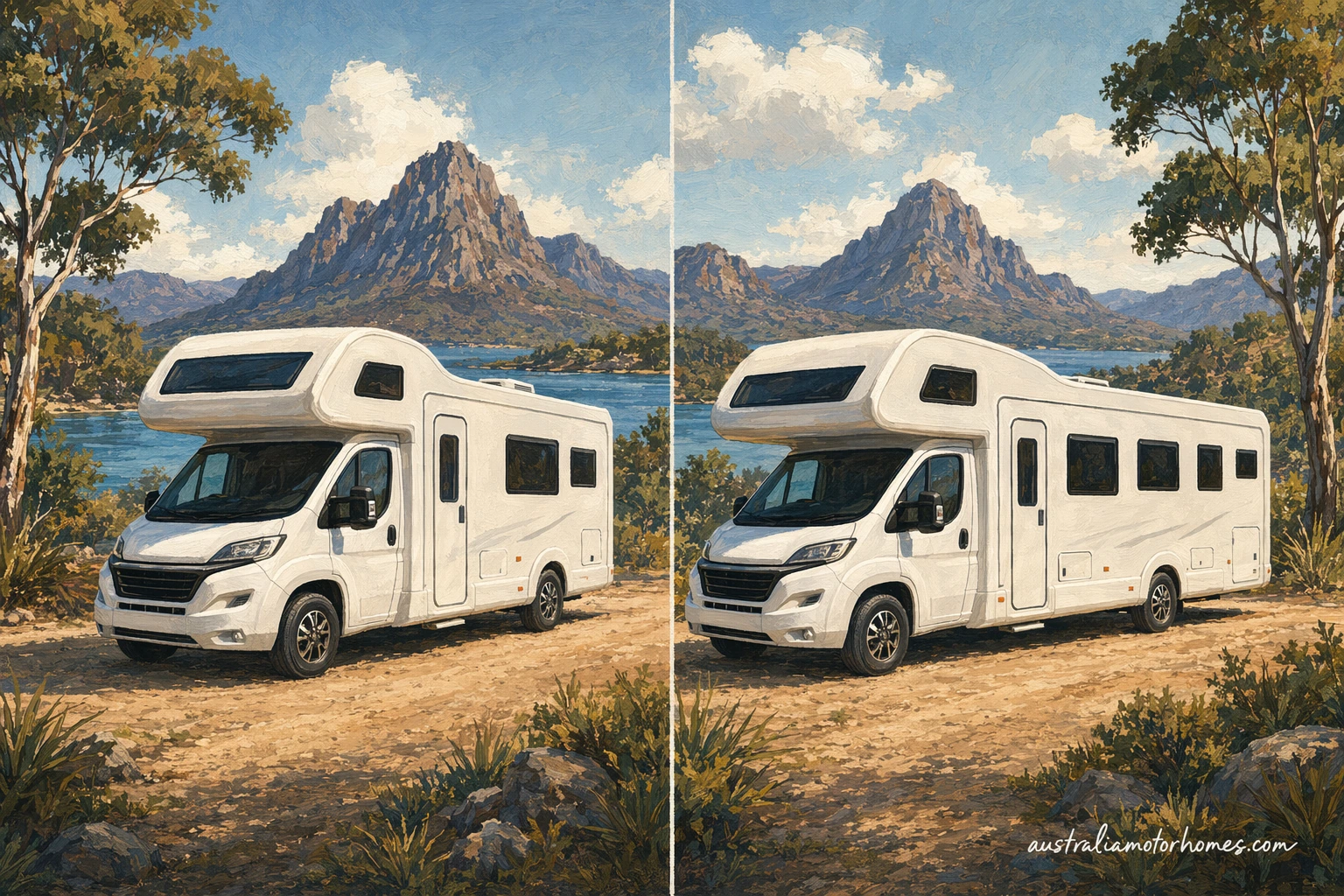 australiamotorhomes.com
 | USUAL LENGTH | 4 berth 6.7–7.2 m · 6 berth 7.5–8.2 m |
|---|---|
| HEIGHT WATCH | Often 3.0–3.4 m · avoid low carparks |
| FUEL USE | About 12–15 vs 14–18 L/100 km |
| BEST CREW | 4 berth: 2–4 · 6 berth: 4–6 |
| CAMPSITES | 7 m easier · 8–9 m sites safer for big rigs |
| LICENCE | Usually car licence under 4.5 t GVM |
If there are two adults and one or two kids, a 4 berth motorhome is often the sweet spot. You still get proper beds, an onboard kitchen, usually a shower and toilet, and enough cupboard space for a Big Lap wardrobe that is mostly thongs, fleece and one emergency nice shirt.
A 6 berth makes sense when there are four to six people, taller teenagers, grandparents joining part of the run, or you simply cannot face packing down beds every morning. The trade-off is real: most 6 berth motorhomes are longer, heavier and thirstier, and they can be barred from smaller sites that a 4 berth slips into without drama.

A typical 4 berth rental motorhome sits around 6.7–7.2 metres long. Many 6 berth models are closer to 7.5–8.2 metres, sometimes longer depending on the layout. That extra metre matters when you are reversing into a caravan park site at 4 pm while a retired bloke in a camp chair offers silent judgement over his stubby.
Height is the other trap. Plenty of motorhomes sit around 3.0–3.4 metres high, so underground supermarket carparks, drive-through bottle-o lanes and leafy council parking areas are not your friends. In older towns, kerbs, awnings and tight roundabouts can turn a quick grocery stop into a three-point public performance.
In a 4 berth, the usual setup is two double beds: one may be over the cab and the other converts from the rear lounge or dinette. It is fine for a family that runs on patience, but if both beds need daily converting, your mornings can become a ballet of pillows, cereal bowls and someone asking where the other shoe went.
A 6 berth often gives you three sleeping zones, commonly an over-cab bed, a rear bed and a dinette conversion. The big win is not just sleeping six; it is being able to leave one bed made up while still having somewhere to sit when the weather turns foul in Tasmania or a Top End storm dumps 40 mm in an hour.

Rental motorhomes vary, but a 4 berth commonly uses about 12–15 L/100 km in mixed touring. A 6 berth can sit around 14–18 L/100 km, and more into headwinds, hills or when you are pushing 100 km/h across the Nullarbor. Over 3,000 km, that difference can be 60–150 litres of diesel, depending on the van and your right foot.
Then come the quiet costs. Some caravan parks charge by occupants, not van size, so six people may cost more regardless of berth. Ferries and some attractions price by vehicle length. Extra LPG, extra laundry and extra snacks at the servo also have a way of multiplying, especially with teenagers who believe a pie is a food group.
A 4 berth can open more doors for low-cost camping because it is easier to fit marked bays, smaller showgrounds and national park sites. But free camping is not a universal right in Australia. Councils set rules, signs matter, and fines can land around the $150–$300 mark in some areas if you sleep where overnight camping is banned.
Many free camps require self-contained vehicles, which usually means onboard toilet, greywater management and no waste on the ground. A 6 berth may have bigger tanks, which helps for 24–48 hour stays, but more people fill those tanks faster. Six showers, even quick navy showers, will humble a water tank before breakfast.
For a couple doing Adelaide to the Flinders Ranges, Brisbane to K’gari country, or a Perth-to-Margaret-River food-and-coast loop, a 4 berth often feels roomy without becoming a barge. It is also the better learner vehicle if this is your first motorhome hire and your previous camping experience is one leaky tent at Meredith in 2009.
For a family crossing long distances, the 6 berth earns its keep. On a 600 km day between outback towns, being able to rotate seats, store more food and keep a made-up bed can be the difference between fond memories and a mutiny near the next roadhouse.
Best first night for a 6 berth: no heroic reversing, easy power, water nearby and room to learn the awning.

Often roomier than older caravan parks, with basic facilities and a practical feel that suits longer vans.

Great for a 4 berth if the listed maximum vehicle length suits; book ahead where required and arrive before dark.
Check the camper, the dates and the price online, then book it — no quotes, no waiting around.
Check availability & book ›