AM australiamotorhomes.com Check availability
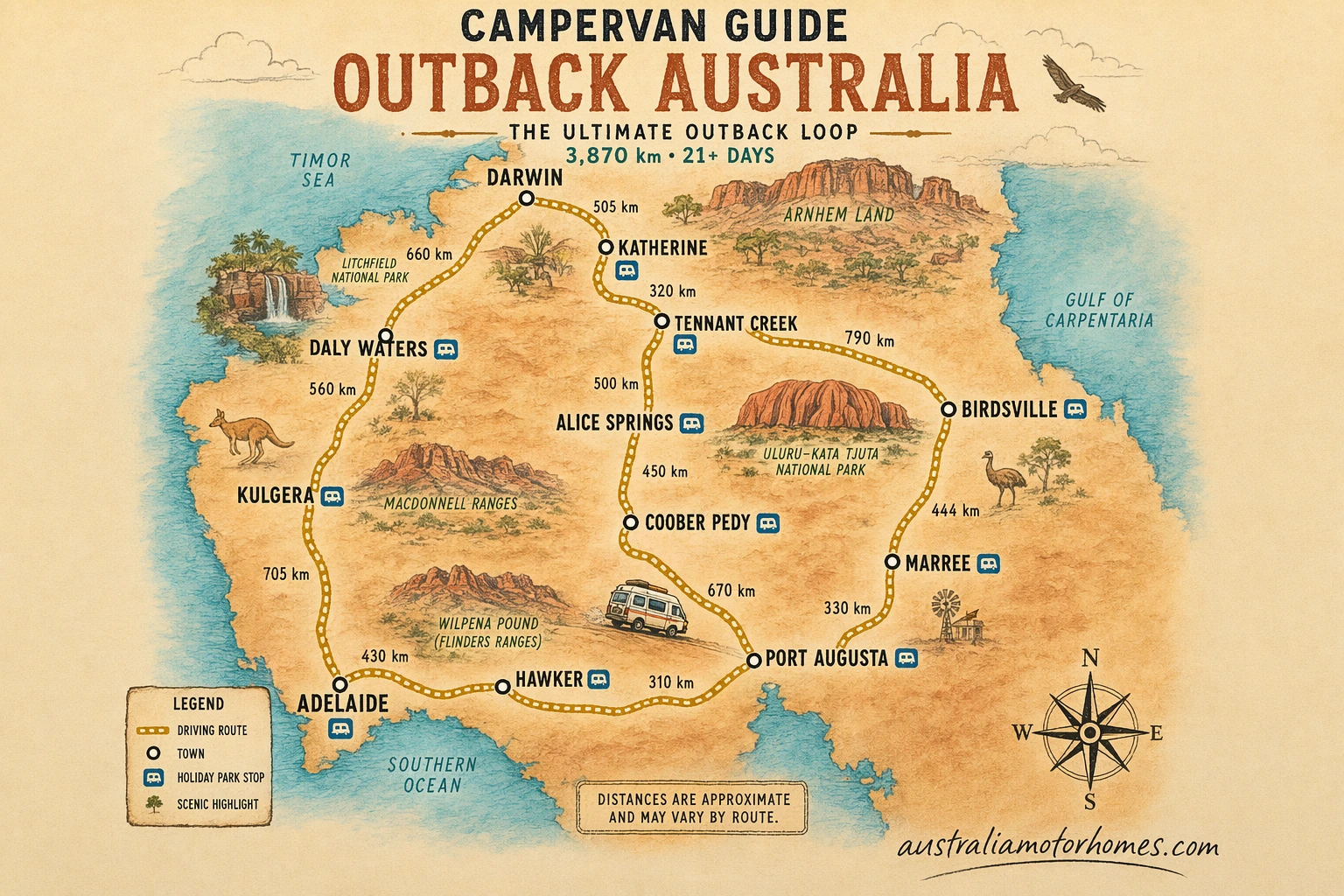
Illustrated route map — A self-driver campervan guide outback Australia can actually use
RED DUST READY

A self-driver campervan guide outback Australia can actually use

australiamotorhomes.com

You do not need a 4WD to see the Red Centre. You do, however, need a sensible fuel range, a booked place to sleep, and the humility to let a road train have the whole road if it wants it.

This campervan guide outback australia is for self-drivers hiring a campervan or motorhome and sleeping in it: powered sites, unpowered bush-style stops, dump points, sealed-road loops, heat, water and the awkward question of where the loo cassette goes after three days.

BEST STARTAlice Springs
SEALED LOOPAbout 1,490 km
IDEAL TIME7–12 days
LONG FUEL LEG305 km Yulara–Kings Canyon
ROAD TYPE2WD sealed route
PEAK SEASONMay–September
01

The sealed outback loop that does not punish your hire vehicle

The classic first-timer outback campervan run is not the whole continent. Start with the Red Centre: Alice Springs, the West MacDonnell Ranges, Uluru, Kata Tjuta and Kings Canyon. It gives you big-sky Australia without sending a 2WD motorhome onto roads your rental agreement may quietly hate.

Expect long, simple driving rather than complicated navigation. The catch is spacing: Alice Springs to Erldunda is about 200 km, Erldunda to Yulara about 244 km, and Yulara to Kings Canyon about 305 km. That is a lot of mulga, heat shimmer and one servo doing the work of a suburb.

  • Do: fill the tank whenever you can once you leave Alice Springs, even if it feels too soon.
  • Do not: plan to average city speeds; 90–100 km/h is more realistic in a high-roof campervan with crosswinds.
  • Watch for: cattle, wedge-tailed eagles on roadkill, floodway dips and road trains needing 1 km or more to pull up.
The sealed outback loop that does not punish your hire vehicle
02

Where you actually sleep: parks, national parks and legal free stops

Outback camping is a mix of holiday parks with powered sites, national park campgrounds with toilets but no plug-in luxury, roadhouse paddocks, and roadside rest areas that are fine for a sleep but not a three-day annex-and-clothesline festival. If you are in a motorhome outback route with a toilet and grey-water tank, you still need to use dump points properly.

Uluru-Kata Tjuta National Park has no camping inside the park. Most self-drivers stay at Yulara or break the journey at Curtin Springs. In Tjoritja / West MacDonnell National Park and Watarrka / Kings Canyon, campgrounds are generally booked online and rangers do check. In busy grey-nomad season from May to September, the good sites go early.

  • Powered sites: best for air-con, charging devices and topping up house batteries before remote legs.
  • Unpowered sites: cheaper and quieter, but manage fridge draw, lights and water pumps carefully.
  • Free camps: use signed rest areas only, keep stays short, and never dump grey water or toilet waste on the ground.
03

Fuel, water, LPG and dump points: the unglamorous stuff that saves the trip

The outback is very good at exposing lazy planning. A headwind can lift fuel use in a campervan from a neat brochure number to 14–18 L/100 km, and a hot day can make two people drink 6 litres of water before lunch. Carry more than you think you need.

A practical minimum is 10 litres of drinking water per person per day plus a reserve, especially if you are walking. Top up potable water in Alice Springs, Yulara and major roadhouse or holiday park stops where available. Dump points are commonly found in larger towns and many holiday parks; access may depend on staying there, so do the polite thing and ask before rolling in with a full cassette.

  • Fuel rule: refill at Alice Springs, Erldunda, Yulara and Kings Canyon rather than gambling on the next bowser.
  • LPG: do not assume every servo can swap or refill bottles; check before you are down to cold baked beans.
  • Water: separate drinking water from general tank water if your van setup allows it.
  • Waste: use dump points only; fines and ranger conversations are both avoidable.
Fuel, water, LPG and dump points: the unglamorous stuff that saves the trip
04

Dirt roads, 4WD limits and the tempting shortcut

On the map, the Mereenie Loop looks like the clever way from the West MacDonnell Ranges to Kings Canyon. On a rental agreement, it may look like an expensive mistake. Parts are unsealed, conditions change after rain, and many standard 2WD campervan and motorhome hire contracts exclude unsealed roads except short, approved campground access tracks.

The same caution applies to the Tanami, Oodnadatta Track, Birdsville Track, Palm Valley and plenty of minor station roads. Some are legendary Big Lap material, but legends also have tyre sidewalls, underbody damage and recovery bills. If you want dirt-road outback, book a vehicle specifically allowed to do it and check restrictions online before committing.

  • Do: stick to the sealed Stuart, Lasseter and Luritja Highways for a standard Red Centre campervan loop.
  • Do not: follow a mapping app onto a shortcut just because it saves 80 km on screen.
  • After rain: never drive through signed closed roads; penalties can be severe and insurance may not cover you.
05

Things to do in an outback campervan without rushing like a galah

The best things to do outback campervan style happen early, late, or slowly. The Uluru base walk is about 10.6 km, the Kings Canyon Rim Walk is about 6 km, and the full Valley of the Winds circuit at Kata Tjuta is about 7.4 km. In summer, that is not a casual post-lunch wander; it is a pre-sunrise alarm and two water bottles each.

Give the West MacDonnell Ranges at least one night if you can. Simpsons Gap, Standley Chasm, Ellery Creek Big Hole and Ormiston Gorge are all reachable on sealed roads or short access roads in normal conditions, and they break up the red-dirt driving with shade, waterholes and rock walls that turn ridiculous colours before sunset.

  • Best season: May to September for cooler days, though nights can drop below 5°C in the desert.
  • Summer reality: 35–42°C days are common; some walks close when heat risk is high.
  • Cultural respect: follow signs at sacred sites, stay on tracks and do not climb restricted areas.
  • Booking tip: if your dates hit school holidays or peak grey-nomad migration, check vehicle availability online early.
SHORTLIST

Sort your first night

Alice Springs powered holiday park
powered holiday park

Alice Springs powered holiday park

Good first-night shakedown for water, power, groceries, bottle-o run and learning which cupboard rattles.
Ormiston Gorge Campground
NP campground

Ormiston Gorge Campground

Unpowered West MacDonnell base with toilets, walks and sunset rock walls; book online before arrival.

Curtin Springs Wayside Stop
roadhouse camp

Curtin Springs Wayside Stop

Useful break between Erldunda, Uluru and Kings Canyon, with basic traveller services in proper outback country.

LEG BY LEG

The drive, broken down

  1. Alice Springs to Ormiston Gorge135 km · 2 hr

    Sealed West MacDonnell drive with gorge stops; book national park camping ahead.

  2. Ormiston Gorge to Erldunda335 km · 4 hr 15

    Return via Alice Springs and the Stuart Highway; refuel before leaving town.

  3. Erldunda to Yulara244 km · 2 hr 45

    Straight Lasseter Highway run with big views and few services.

  4. Yulara to Kings Canyon305 km · 3 hr 40

    Sealed via Lasseter and Luritja Roads; leave with a full tank and water.

  5. Kings Canyon to Alice Springs474 km · 5 hr 30

    Long sealed return via Luritja, Lasseter and Stuart Highways; start early.

“You do not need a 4WD to see the Red Centre.”

australiamotorhomes.com
STRAIGHT ANSWERS

Questions self-drivers actually ask

Can I drive an outback campervan route without a 4WD?
Yes, if you choose the right route. The Red Centre loop using the Stuart, Lasseter and Luritja Highways is sealed and suitable for many 2WD campervans and motorhomes in normal conditions. Avoid unsealed shortcuts unless your hire terms specifically allow them.
How many days do I need for an outback motorhome trip?
Allow at least 7 days for Alice Springs, Uluru and Kings Canyon, and 10–12 days if you want the West MacDonnell Ranges without rushing. Distances look tidy on a map but heat, fuel stops and early-morning walks slow the pace.
Is free camping allowed in the outback?
Sometimes, but not everywhere. Use signed roadside rest areas, council-approved free camps or permitted sites, and keep it low-impact. National parks usually require booked, paid campgrounds, and Uluru-Kata Tjuta does not allow camping inside the park.
Where do I empty the toilet cassette in the Red Centre?
Use designated dump points in larger towns, holiday parks and some roadhouse-style stops. Alice Springs and Yulara are the key places to plan around, with other options changing by access and season. Never empty toilet waste in bushland, pit toilets or roadside bins.
What is the biggest fuel gap on this suggested loop?
The Yulara to Kings Canyon leg is about 305 km, and Kings Canyon back to Alice Springs via the sealed highway is about 474 km. Fuel is available at major stops, but opening hours and supply can vary, so top up whenever you can.
When should I book a campervan for the outback?
For May to September, book early because cooler weather brings grey nomads, school-holiday families and Big Lap travellers into the same few campgrounds. Check availability online once your dates are roughly set, then match your vehicle to sealed-road or approved 4WD travel.
BOOK ONLINE · 180+ COUNTRIES

Lock in your dates and get rolling

Check the camper, the dates and the price online, then book it — no quotes, no waiting around.

Check availability & book