Campervan supplies Sydney: where to stock up before you roll
The hardest part isn’t the keys — it’s where you put the groceries, fill the water tank, find LPG and avoid discovering at 9 pm that your hired campervan is too tall for the supermarket car park.
This guide is for self-drivers sleeping in the van: first-timers, grey nomads starting a Big Lap, and anyone pointing the bonnet out of Sydney with a fridge to fill. You’ll get practical stop logic for supermarkets Sydney campervan crews can actually use, plus LPG, fuel, water, dump points and laundry jobs before the road opens up.
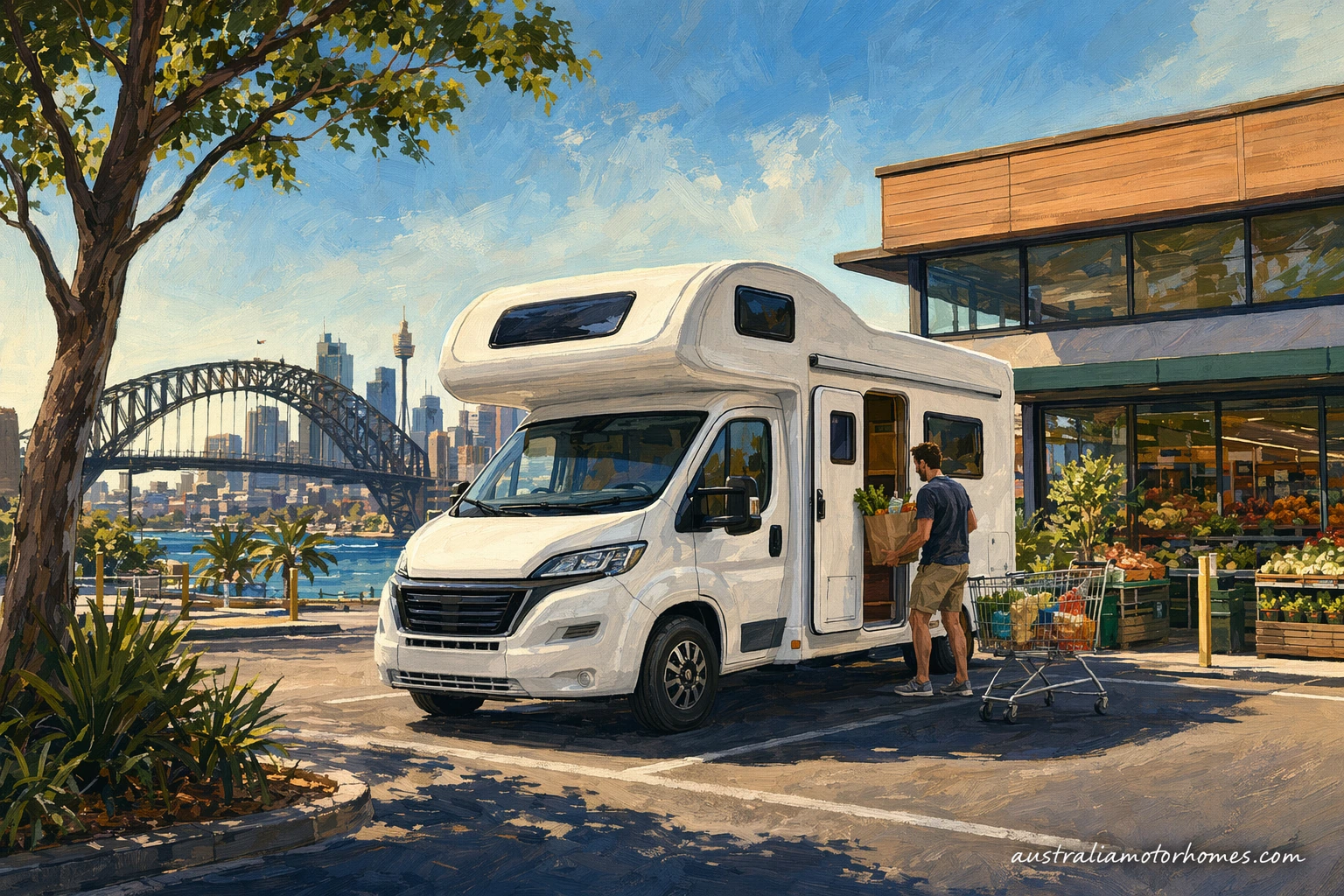 australiamotorhomes.com
 The practical checklist
- ✓Do: choose supermarkets with open-air parking, early-morning access and room to swing wide.
- ✓Don’t: drive into an underground car park because the GPS says “3 minutes faster”. It is lying by omission.
- ✓Do: shop for 3 days of meals first, not 3 weeks. Sydney has choice; your campervan fridge has physics.
- ✓Don’t: block loading docks or bus zones while “just ducking in”. Rangers in Sydney are not sentimental.
- ✓Do pack: wraps, eggs, tinned tomatoes, rice or couscous, long-life milk, coffee, fruit that can take a bump, and one emergency dinner that needs no fridge.
- ✓Do pack: toilet chemical if your hire vehicle uses a cassette, bin bags, biodegradable wipes, pegs, a torch and insect repellent.
- ✓Don’t pack: glass-heavy fancy sauces, giant watermelon, or six kinds of cheese unless you enjoy fridge Tetris.
- ✓Do: buy alcohol at a bottle-o before rural closing times; rules and hours vary, especially near public holidays.
Easy loops out of here

Pick your shopping zone before you enter the CBD maze
Sydney is brilliant at harbour views and fairly hopeless at giving a 2.8 m-high campervan somewhere calm to park. The trick is to provision outside the tightest inner suburbs unless you genuinely enjoy one-way streets, impatient utes and car parks that announce a 2.1 m height limit after you’ve committed.
For most hires, do the big stock-up in an outer or middle-ring area on your way out: south-west for Canberra, the Blue Mountains or Melbourne; north-west for the Hunter and Brisbane; south for Wollongong and the coast. Large shopping centres often have open-air bays around the edges, but always check height signs before entering any undercover section.
- Do: choose supermarkets with open-air parking, early-morning access and room to swing wide.
- Don’t: drive into an underground car park because the GPS says “3 minutes faster”. It is lying by omission.
- Do: shop for 3 days of meals first, not 3 weeks. Sydney has choice; your campervan fridge has physics.
- Don’t: block loading docks or bus zones while “just ducking in”. Rangers in Sydney are not sentimental.

What to buy for the first 600 km, not the whole continent
A first provisioning run goes wrong when people buy like they own a pantry. In a motorhome, every rattling jar becomes percussion by Penrith. Aim for meals that survive heat, movement and the mild indignity of being cooked beside a servo forecourt in crosswind.
If you’re heading west, towns thin out after the Blue Mountains and again beyond Dubbo or Bathurst. If you’re heading north, the Pacific Highway is well serviced but holiday weekends can turn simple stops into queue theatre. Keep drinking water separate from tank water; 10–15 litres of bottled or jerry-can drinking water per two people is a sensible buffer.
- Do pack: wraps, eggs, tinned tomatoes, rice or couscous, long-life milk, coffee, fruit that can take a bump, and one emergency dinner that needs no fridge.
- Do pack: toilet chemical if your hire vehicle uses a cassette, bin bags, biodegradable wipes, pegs, a torch and insect repellent.
- Don’t pack: glass-heavy fancy sauces, giant watermelon, or six kinds of cheese unless you enjoy fridge Tetris.
- Do: buy alcohol at a bottle-o before rural closing times; rules and hours vary, especially near public holidays.
Fuel stations Sydney: fill before the freeway habit kicks in
Most self-drive campervans leave Sydney with enough fuel to get moving, but “moving” and “comfortable range” are different things. A 2-berth camper might use around 10–13 L/100 km; a larger motorhome can sit closer to 13–16 L/100 km, more with headwinds, hills, air-conditioning and a heavy right boot.
Fill before you join the long run out. Once you’re on the M1, M4, M5 or Hume, service centres are convenient but not always the cheapest. A realistic planning range is 450–650 km depending on tank size and vehicle, but in Australia you refill by opportunity, not by optimism. Road trains may be rare near Sydney, but get into western NSW and you’ll learn to leave them room.
- Do: start the first highway leg with a full tank and known tyre pressures.
- Don’t: wait for the fuel light outside metro areas; the next servo may close early or be 80 km away.
- Do: check whether your vehicle takes diesel or petrol before touching the bowser. The sticker near the fuel cap is your friend.
- Don’t: park across two pump lanes while rearranging the fridge. Fuel stations Sydney-wide can be frantic.

LPG, water and the little jobs that save the first night
Cooking gas is easy to forget because it sits quietly until dinner. Before leaving the metro area, confirm whether your hired van has a swappable bottle, refillable LPG cylinder or built-in appliance supply, and follow the hire operator’s instructions. Not every servo does LPG bottle refills, and some only swap standard bottle sizes.
For water, use signed potable taps only. Many holiday parks allow guests to fill tanks, and some public dump point sites include water, but not all water near a dump point is drinking water. If the tap is marked non-potable, believe it. Sydney heat can push above 35°C in summer, and a half-empty tank becomes annoying very quickly when everyone wants a shower.
- Do: top up fresh water before your first camp, even if the gauge says “mostly full”. Gauges are sometimes more artistic than scientific.
- Do: keep a short drinking-water hose separate from the grey-looking mystery hose used near dump points.
- Don’t: assume every lpg refill Sydney search result suits campervan bottles; ring ahead only if your setup is unusual.
- Don’t: fill from beach showers, park irrigation taps or anything labelled non-potable.
Dump points, laundromats and the unglamorous Sydney exit checklist
A dump point Sydney stop is best handled before you urgently need one. Cassette toilets are simple: empty only at signed dump points, rinse responsibly, and never tip waste into public toilets, stormwater drains or the bush. Councils and campgrounds take this seriously because, frankly, humans are the reason rules need laminating.
A laundromat Sydney stop is worth doing before the first wet week on the coast or a dusty inland run. Choose one with street-level access nearby, send one person in with the washing, and keep the driver with the van if parking is tight. In humid weather, wet towels can turn a campervan into a suspicious swamp in under 24 hours.
- Do: empty the toilet cassette before returning to dense traffic or crossing into national park camping areas.
- Do: carry $1 and $2 coins or a card for laundries; payment systems vary.
- Don’t: use national park toilets as dump points. It is illegal, feral and a quick way to get fined.
- Do: plan chores in one loop: supermarket, fuel, LPG, water, laundry, dump point, then camp.
Where to sleep after stocking up: don’t wing Sydney on night one
Sydney is not the place to freestyle a roadside sleep in a hired motorhome. Many foreshore streets, beach suburbs and council car parks have overnight restrictions, and fines can be painful. Book a powered or unpowered site for the first night if you are new to the vehicle; it gives you space to learn the awning, fridge, water pump and cassette without an audience of peak-hour commuters.
National parks around Sydney often require bookings and fees, and many gates have set hours. Free camping close to the city is limited and frequently restricted. Once you’re beyond the metro fringe, options open up, but the first evening is better spent levelling the van than arguing with a “No Camping” sign under a streetlight.
- Do: book the first night before arrival, especially in school holidays and summer weekends.
- Don’t: assume “self-contained” means you can camp anywhere. Local signage wins.
- Do: arrive before dark; Sydney traffic plus an unfamiliar reversing camera is not romance.
- Do: check availability online early if you need a specific campervan size, toilet/shower layout or automatic transmission.
Lock in your dates and get rolling
Check the camper, the dates and the price online, then book it — no quotes, no waiting around.
Check availability & book ›