
powered holiday park
Lane Cove Holiday Park
Leafy north-side base with city access by public transport and a calmer first-night feel than the CBD.
The hardest part isn't the keys — it's where you sleep that first night. Sydney looks simple on a map until your campervan is 2.8 m high, the bridge toll is cashless, the beach car park says 2.1 m clearance, and every local seems to know a secret back street you absolutely do not.
Check availability ›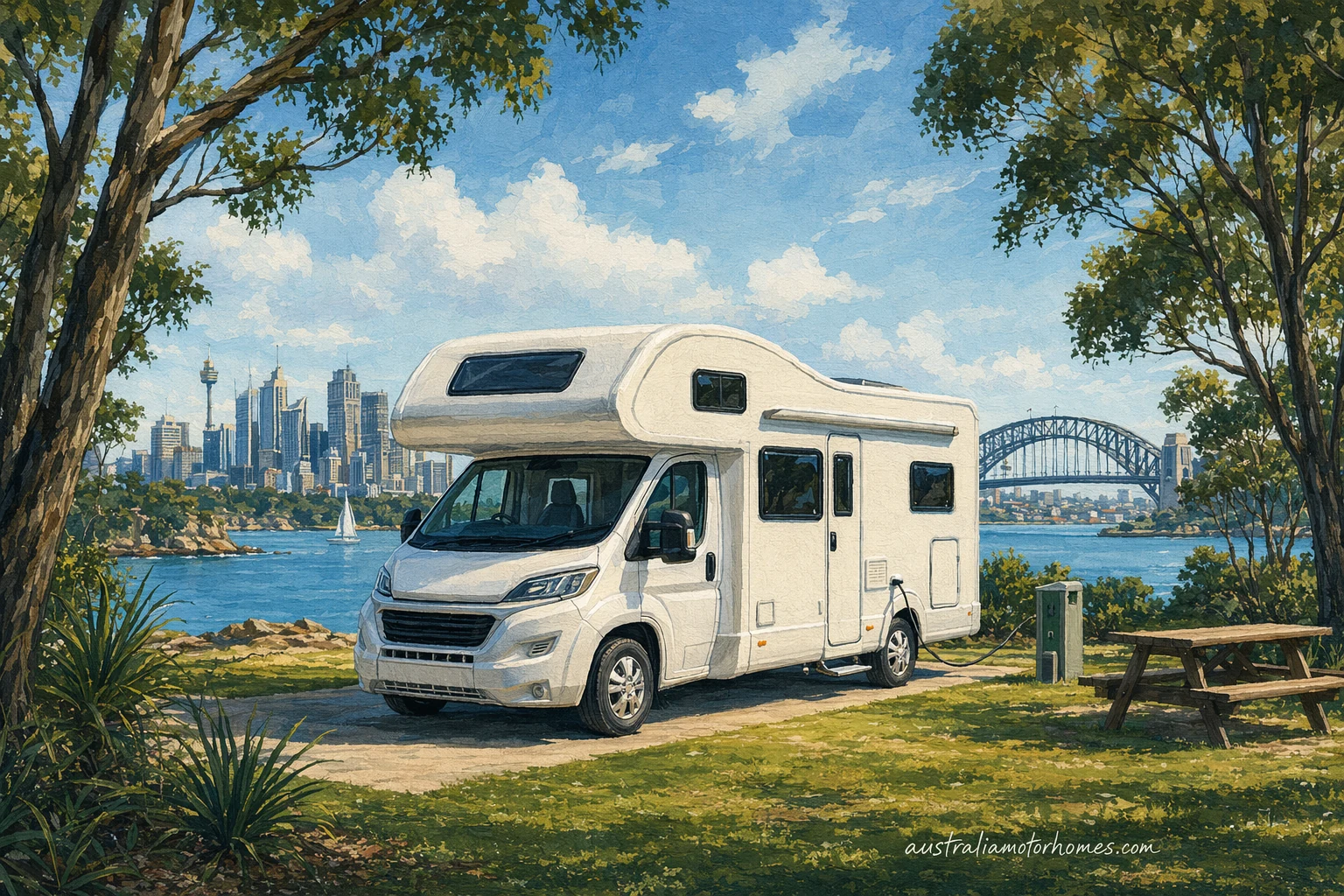 australiamotorhomes.com
 The hardest part isn't the keys — it's where you sleep that first night. Sydney looks simple on a map until your campervan is 2.8 m high, the bridge toll is cashless, the beach car park says 2.1 m clearance, and every local seems to know a secret back street you absolutely do not.
This guide is for self-drivers sleeping in the van, not suitcase-and-hotel travellers. You'll find practical holiday parks Sydney campervan hirers can use, what is walkable, where powered sites make sense, how to dodge CBD parking misery, and when to check availability online before the grey nomads grab the good bays.
Leafy north-side base with city access by public transport and a calmer first-night feel than the CBD.

Beach-and-lagoon location with buses nearby; book early for summer powered sites.

North-west option with more breathing room for longer motorhomes and highway departures.

Useful outer-west base for self-drivers heading towards the Blue Mountains or Hawkesbury.
South-west fringe choice for easier road access, fewer city nerves and larger-vehicle manoeuvring.
National park-style camping west of Sydney; check vehicle suitability, bookings and no-powered-site rules.
Sydney is not a free-camping playground with an Opera House view and a polite ranger handing you a cuppa. Most beachside and foreshore streets have no camping or no overnight parking signs, and councils do enforce them. Fines commonly sit around the $120–$300 mark, which is a dreary way to remember Bondi.
The useful holiday parks sit on the edges: north around Narrabeen and Lane Cove, north-west around Dural and Vineyard, or south-west towards Camden. That sounds far until you remember Sydney traffic can turn 18 km into 55 minutes before breakfast.

If you're new to camping Sydney in a hired campervan, book a powered site for the first night or two. It gives you 240 V power, time to sort the fridge, charge devices, learn the toilet cassette routine and discover which cupboard holds the frypan before dark.
Unpowered campsites around Sydney can be cheaper and pleasant, but they are not always available inside holiday parks and may not suit larger motorhomes. Dump points are usually park-specific rather than sprinkled around the city like servos, so confirm access when booking, especially if your van has a cassette toilet or grey-water tank.
If you want sand in your thongs and a swim before breakfast, the northern beaches are the prize. North Narrabeen gives you lagoon, surf beach and bus access, but sites book hard in summer. It is one of the few places where campsites Sydney visitors picture in their head actually match the brochure-ish fantasy, minus the parking stress.
Lane Cove is the smarter first-night base for many van hirers: leafy, quieter than expected, and close enough to trains or metro connections for a city day without moving the rig. Larger motorhomes and Big Lap travellers often prefer the north-west or south-west fringe, where roads are broader and reversing into a bay does not require a spotter, a prayer and three interested cockatoos.
Sydney's motorways are efficient, expensive-looking and entirely cashless. The M2, M4, M5, M7, M8, Eastern Distributor, Harbour Bridge and Harbour Tunnel are all electronic toll roads. Your hire vehicle will usually be linked to a toll arrangement, but read the paperwork before you go full suburban rat-run.
Height is the bigger gotcha. Many campervans sit around 2.6–3.2 m high, while shopping-centre and beach car parks often cap out at 2.1 m. Some low railway bridges and tight suburban streets are also unfriendly to long-wheelbase vehicles. If you're collecting near the airport, avoid the inner-city sightseeing urge; get groceries, head to your park, plug in, then use train, bus, ferry or rideshare.
From late December to the end of January, Sydney holiday parks behave like beachfront real estate with power leads. Easter, October long weekend and school holidays also fill quickly. If your plan is to roll in at 5 pm on a Friday and ask for a waterfront powered site, the receptionist may laugh internally, which is worse.
Winter is easier, with daytime temperatures often around 16–18°C, cool nights and less competition for sites. Summer can push past 30°C, and a powered site means you can run approved appliances and charge fans or devices. If you are starting or finishing a Big Lap here, book the first and last nights online so you are not hunting a site after returning the bottle-o supplies and trying to repack the van in a southerly.
Leafy north-side base with city access by public transport and a calmer first-night feel than the CBD.
Beach-and-lagoon location with buses nearby; book early for summer powered sites.
North-west option with more breathing room for longer motorhomes and highway departures.
Check the camper, the dates and the price online, then book it — no quotes, no waiting around.
Check availability & book ›